Category: Politics

  • The Real C-Suite Acronym Guide: What Those Titles Actually Stand For

    Every org chart has a row of three-letter acronyms at the top. They’re supposed to convey authority and responsibility. They do not. Here is what they actually stand for.


    CEO — Chief Executive Officer

    • Chief Ego Officer — the one whose “vision” is just whatever they heard at Davos last week.
    • Chief Email Officer — forwards articles to the whole leadership team at 11pm with “Thoughts?” and no other context.
    • Chief Excuse Officer — misses every target but has a pristine narrative for the board about “headwinds.”
    • Chief Exit Officer — already interviewing at a bigger company, but talks constantly about being “all in.”
    • Chief Entourage Officer — never travels to a meeting without three direct reports who sit silently.
    • Chief Evasion Officer — hasn’t given a straight answer to a direct question since 2019.

    COO — Chief Operating Officer

    • Chief Overthinking Officer — turns a simple process into a 47-slide deck with a RACI matrix.
    • Chief Obstacle Officer — every new idea has to survive their gauntlet of “have we thought about…” questions.
    • Chief Overworked Officer — does the actual work while the CEO takes the credit on stage.
    • Chief Obvious Officer — “We need to execute better.” Groundbreaking.
    • Chief Org-chart Officer — redraws reporting lines quarterly and calls it strategy.
    • Chief Over-process Officer — added seven approval steps to what used to be a Slack message.

    CFO — Chief Financial Officer

    • Chief Frugality Officer — denies your $12/month SaaS tool, approves a $3M consulting engagement.
    • Chief Fear Officer — every all-hands contribution starts with “just to be transparent about the numbers.”
    • Chief Forecasting Officer — missed projections four quarters running but the spreadsheet is immaculate.
    • Chief Finger-pointing Officer — revenue miss? That’s a sales problem. Cost overrun? That’s engineering’s fault.
    • Chief Footnote Officer — buries the real story in appendix C of the board deck.
    • Chief Freeze Officer — institutes a hiring freeze every Q3 like it’s a seasonal tradition.

    CTO — Chief Technology Officer

    • Chief Theoretical Officer — hasn’t written production code since 2011 but has strong opinions about your architecture.
    • Chief Tomorrow Officer — every solution is “the platform we’re building next quarter” which never ships.
    • Chief Tooling Officer — migrates the entire stack to a new framework every 18 months.
    • Chief Technical-debt Officer — the person most responsible for the debt who now presents a roadmap to fix it.
    • Chief Thought-experiment Officer — “What if we rewrote everything in Rust?” No. Sit down.
    • Chief Trend Officer — Kubernetes, then serverless, then AI, then whatever’s next on the Gartner hype cycle.

    CMO — Chief Marketing Officer

    • Chief Meaningless Officer — “We’re not selling software, we’re enabling transformative human potential.”
    • Chief Musical-chairs Officer — average tenure of 18 months. Already updating their LinkedIn bio.
    • Chief Merch Officer — solves brand problems with swag. Low NPS? Have a tote bag.
    • Chief Metrics Officer — talks about “brand awareness” whenever anyone asks what marketing actually delivered.
    • Chief Mood-board Officer — spent $80K on a brand refresh that changed the blue by two hex values.
    • Chief Misspend Officer — the Super Bowl ad seemed like a good idea at the time.

    CIO — Chief Information Officer

    • Chief Irrelevance Officer — still presenting a “digital transformation roadmap” in 2026.
    • Chief Inertia Officer — manages a terrifying web of legacy systems held together by hope and one contractor.
    • Chief Inhibition Officer — the reason you still can’t use the tool you need.
    • Chief Invoice Officer — primarily exists to manage vendor relationships with Oracle and Microsoft.
    • Chief Inaction Officer — has been “evaluating” a cloud migration for four years.
    • Chief Invisible Officer — you forget they exist until something breaks catastrophically.

    CHRO — Chief Human Resources Officer

    • Chief Handbook-Recitation Officer — answers every nuanced human question by quoting policy section 4.3.2.
    • Chief Holiday-party Responsibility Officer — the one visible initiative that gets full executive support.
    • Chief Hollow-Reassurance Officer — “We value our people” is doing a lot of heavy lifting in that sentence.
    • Chief Hiring-freeze Ratification Officer — communicates the bad news the CFO was too cowardly to deliver.
    • Chief HR-speak Refinement Officer — turns “you’re fired” into “we’re creating space for your next chapter.”
    • Chief Happy-Return-of-your-Badge Officer — makes the offboarding process feel like a spa checkout.

    CLO — Chief Legal Officer

    • Chief Logjam Officer — innovation goes to Legal to die quietly.
    • Chief Liability Officer — sees existential risk in a blog post.
    • Chief Litigation Officer — the reason every Slack message now feels like a deposition transcript.
    • Chief Leverage Officer — somehow has veto power over everything but reports to no one.
    • Chief Latency Officer — adds 6-8 weeks to any launch with “just a quick legal review.”
    • Chief Legalese Officer — turns a two-sentence agreement into forty pages nobody reads.

    CSO — Chief Strategy Officer

    • Chief Slide Officer — produces beautiful decks that nobody executes on.
    • Chief Stating-the-obvious Officer — “Our strategy is to grow revenue and reduce costs.” Thanks.
    • Chief Sometime Officer — everything is a “3-to-5-year play.” Conveniently unverifiable.
    • Chief Stolen-credit Officer — repackages what product already shipped as “strategic wins.”
    • Chief Synthesis Officer — their entire job is combining other people’s ideas into a framework with a name.
    • Chief Squint Officer — looks at the same data everyone else has and says “I see it differently.”

    CPO — Chief Product Officer

    • Chief Prioritization Officer — maintains a backlog of 4,000 items, ships three.
    • Chief Post-it Officer — has never met a wall that couldn’t be covered in sticky notes.
    • Chief Pivot Officer — the roadmap changes every sprint based on whatever the loudest customer said.
    • Chief Pipeline Officer — everything is “in the pipeline.” The pipeline is infinite. Nothing exits.
    • Chief Persona Officer — can describe twelve fictional users in vivid detail, has talked to zero real ones this quarter.
    • Chief Parking-lot Officer — “Great idea, let’s park that.” It will never be unparked.

    CPO — Chief People Officer

    • Chief Platitude Officer — “Our people are our greatest asset” said while approving a 2% raise pool.
    • Chief Ping-pong Officer — believes culture problems are solved by office perks.
    • Chief Performative Officer — the “people-first” executive who checks Slack engagement metrics at midnight.
    • Chief Pulse-survey Officer — sends a survey every month, acts on results never.
    • Chief Pep-talk Officer — gives an inspiring speech the week before layoffs.
    • Chief Pizza Officer — morale is low? Let’s do a pizza Friday. Problem solved.

    CRO — Chief Revenue Officer

    • Chief Relentless Officer — “Just circling back” is their love language.
    • Chief Renegotiation Officer — every closed deal gets quietly discounted 40% and still counted as a win.
    • Chief Reorg Officer — restructures the sales team every two quarters and calls it “go-to-market evolution.”
    • Chief Reality Officer — the forecast is always “strong” right up until it isn’t.
    • Chief Rinse-and-repeat Officer — same playbook at every company, regardless of whether it fits.
    • Chief Retention-is-someone-else’s-problem Officer — closes the deal, throws it over the wall, moves on.

    CDO — Chief Data Officer

    • Chief Dashboard Officer — built 200 dashboards nobody looks at.
    • Chief Data-swamp Officer — ingested everything, organized nothing.
    • Chief Denominator Officer — can make any metric look good by changing what you divide by.
    • Chief Deck Officer — presents the same “data maturity model” slide every quarter with the arrow moved slightly right.
    • Chief Dusty-data Officer — built the lake. Nobody swims in it.
    • Chief Definitions Officer — spent eight months getting the org to agree on what “active user” means. They didn’t.

    CISO — Chief Information Security Officer

    • Chief “I Said No” Officer — the answer is no. The answer was always no. The answer will be no.
    • Chief Incident-suppression Officer — there was a thing in 2023. We’ve “remediated.”
    • Chief Insurance Officer — exists primarily to satisfy the cyber liability underwriter.
    • Chief “I Summarized the Audit” Officer — translates 300-page compliance reports into three green checkmarks.
    • Chief Intimidation Officer — the phishing test emails are getting passive-aggressive.
    • Chief Isolation Officer — locked down so many things that half the org is using shadow IT anyway.

    CAO — Chief Administrative Officer

    • Chief Ambiguity Officer — nobody, including them, can clearly articulate what this role covers.
    • Chief “Also” Officer — “I also oversee facilities, and also procurement, and also… what else does nobody want?”
    • Chief Adjacent Officer — sits near power but never quite holds it.
    • Chief Abandoned-projects Officer — the graveyard of programs that other execs got bored of lands here.
    • Chief Afterthought Officer — gets invited to the offsite but not the pre-offsite dinner.
    • Chief Attic Officer — where the org stores responsibilities it doesn’t know what to do with.

    CCO — Chief Communications Officer

    • Chief Carefully-worded Officer — turns “we screwed up” into three paragraphs that say nothing.
    • Chief Copyediting Officer — the CEO’s tweets are their real full-time job.
    • Chief Crisis Officer — only gets executive attention when something is on fire.
    • Chief “Can’t-comment” Officer — their entire job is preventing people from saying true things publicly.
    • Chief Commemoration Officer — writes the all-company email celebrating milestones nobody felt.
    • Chief Cosmetic Officer — makes the layoff announcement sound like a growth story.

    CAIO — Chief Artificial Intelligence Officer

    • Chief Acronym-insertion Officer — their job is putting “AI” in front of things that already existed.
    • Chief Abstract-initiative Officer — “We’re building an AI Center of Excellence.” What does it do? “Excellence.”
    • Chief Announcement Officer — has shipped zero models but issued fourteen press releases.
    • Chief API-key Officer — the entire “AI strategy” is an OpenAI subscription and a prompt template.
    • Chief Anxiety-inducement Officer — tells the board AI will replace everyone, tells employees AI will replace no one.
    • Chief Artificial-importance Officer — the role didn’t exist 18 months ago and may not exist 18 months from now.

    If you recognized your own leadership team in this post, congratulations. You work at every company.

  • The Death of Career Limiting Moves

    Photo by Thirdman : https://www.pexels.com/photo/man-in-white-dress-shirt-sitting-on-chair-in-front-of-table-with-macbook-pro-5060985/

    Remember when they told you to be careful? Don’t rock the boat. Don’t challenge the wrong person. Don’t take that risky project. One wrong move and you’re done, buddy. Toast. Blackballed. Your career over before it started.

    Well, congratulations. You listened. You played it safe. You meticulously avoided every potential landmine, navigated every political minefield with the precision of a bomb disposal expert, and kept your head down for years. And you know what you got for it? A 3% raise and a promotion to Senior Individual Contributor IV, Level 2, Tier B.

    Meanwhile, Silicon Valley’s finest are out here failing upwards like it’s an Olympic sport they invented.

    You know who I’m talking about. The guy who burned through $400 million on an office-sharing company that was just subletting with extra steps and a beer tap. The executive who shipped a product so broken it became a verb for failure. The founder who raised nine rounds of funding for a company that never actually figured out how to make money before selling it to some other sucker for “future potential.”

    These people don’t have careers. They have highlight reels. They don’t make “career limiting moves” – they make “bold bets that didn’t quite pan out but taught us valuable lessons about the market.” When they get fired, they don’t update their LinkedIn status to “seeking opportunities.” They announce they’re “taking time to explore the next frontier” and immediately get ten offers to join boards and three podcast invitations.

    You know what happens when you or I screw up? We get a talking-to from HR. A note in our file. A quiet suggestion that maybe we’re “not the right culture fit” anymore. We don’t get to write a Medium post about our “journey through failure” that gets 50,000 claps. We don’t get invited to speak at conferences about “resilience” and “pivoting.”

    The rest of us are playing chess while they’re playing Calvinball, except they’re also writing the rules and we just found out the board was always on fire anyway.

    You missed one deadline? Career limiting. You pushed back on a bad idea from someone two levels up? Career limiting. You refused to put your name on something you knew was wrong? Definitely career limiting.

    But launch a cryptocurrency that immediately tanked and took a bunch of retail investors’ money with it? That’s just “being early to an emerging space.” Get caught massively overstating your product’s capabilities to investors? That’s “evangelical product vision.” Burn through your entire runway in eighteen months with nothing to show for it? That’s “learning what doesn’t work.”

    The truth is, there are two completely different rule books. There’s the one they gave us – the one about being a “team player” and “managing stakeholder expectations” and “demonstrating consistent delivery.” That one’s real. It applies to you. Follow it carefully. Your annual review depends on it.

    And then there’s the one for people who’ve already made it into the club. That one’s more like guidelines. Suggestions. A vibe. And the main rule is: if you’re already in, you’re probably staying in. Your network is your net worth, and your failures are just proof you’re willing to take risks.

    You know what’s really wild? We all know it’s a scam, and we still play by the rules. We still nervously laugh at our boss’s bad jokes. We still say “let me circle back on that” instead of “that’s a terrible idea.” We still work weekends to hit arbitrary deadlines while watching people who couldn’t code their way out of a paper bag raise Series C funding for an app that’s basically just email with AI slapped on it.

    So here’s to all of us who still believe in career limiting moves. Who carefully craft our LinkedIn profiles to hide the gaps. Who practice our elevator pitches. Who actually try to deliver value instead of just talking about disruption and synergy.

    We’ll be fine. We’ll hit that median, maybe break above it if we’re lucky. We’ll get our cost-of-living adjustments and our occasional promotions. We’ll be employable.

    And they’ll be on their third failed unicorn, sitting on four boards, and somehow still richer than we’ll ever be.

    But at least we’ll have our dignity. And our complete lack of career limiting moves on our permanent record.

    That’s worth something, right?

    …Right?

  • Stack Shanking

    Stack ranking (see Vitality Curve)

    Constantly replacing (or threatening replacement of) the bottom performers on an annual basis seems like incremental optimization. So you get two classes of performers replaced: Ones in a long term slump and ones that are persistent performance problems/bad fits. If you’re looking at machinery, then being unable to distinguish between the temporarily malfunctioning and the permanently broken is of no major consequence. But with humans, if they are temporarily malfunctioning due to life circumstances, personal issues, or recovering from burnout, you’ve just discarded someone who likely has institutional knowledge, established relationships, and could return to being a high performer.

    The real problem is that stack ranking treats your workforce like a statistical distribution that must maintain its shape regardless of actual performance. Got a team of eight excellent engineers? Sorry, two of them are now “bottom performers” by definition. Hired nothing but rockstars this year? Congratulations, some of your rockstars are now officially mediocre.

    This creates perverse incentives. Smart employees learn to avoid teams with other high performers. Why join the infrastructure team full of senior engineers when you could join the feature team with a couple of passengers? You’ll rank higher, and ranking is what matters at review time.

    The statistical absurdity compounds when you realize that the bottom 10% getting cut this year might have been middle-of-the-pack last year, and could be top performers next year—but they’ll never get the chance because we needed to satisfy our quota of ritualistic firings. We’re not optimizing for performance; we’re optimizing for the appearance of optimization, which is a very different thing.

    Meanwhile, the stack ranking process itself consumes enormous amounts of management time that could be spent on actual work. Managers spend weeks arguing over whether Sarah deserves a 3 or a 4, while the real problems—unclear requirements, technical debt, process inefficiencies—remain unaddressed.

    And let’s talk about what happens to team dynamics. The moment you tell people they’re competing against their teammates for survival, collaboration dies. Why would I help you solve that gnarly bug when it might make you rank higher than me? Why would I share that clever solution when keeping it to myself might be the difference between keeping my job and losing it?

    Stack ranking is management by spreadsheet, the corporate equivalent of deciding which child to abandon based on their last report card.

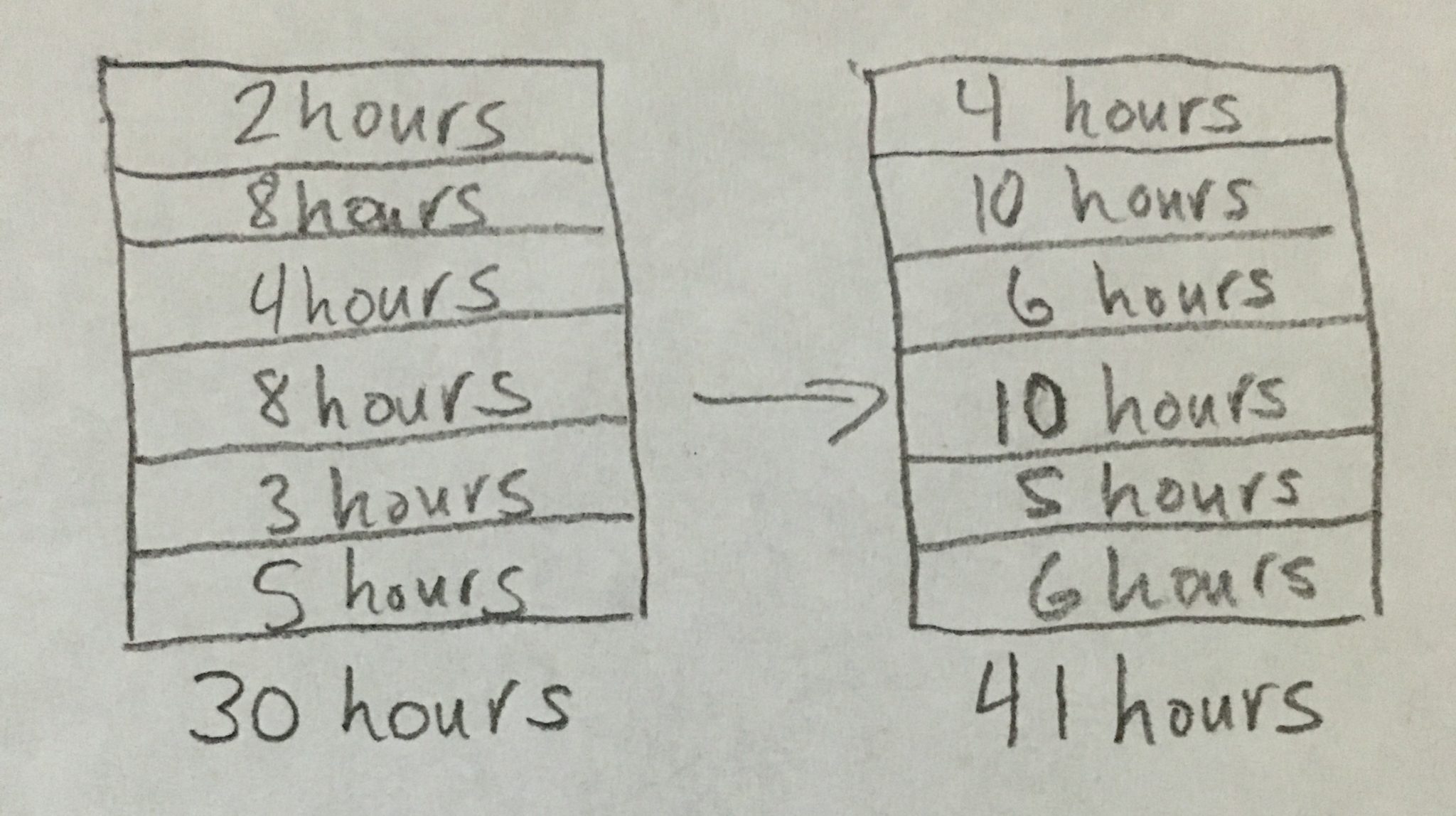
  • Time Bullshitting, Estimates Edition

    What happens when people are given a new baseline for the amount of work expected on tasks for a given week:

  • Crash the Project Plan

    Crash Closed
    Image by Fabio.com.ar via Flickr

    Why in the world would you want to “crash” a project plan? The very use of the word “crash” seems to purvey a sense of doom.

    If you’re not familiar with the “crashing” process, it involves taking a current project plan’s Gantt chart and looking for opportunities to make the chart predict an earlier completion date.

    In some cases, this is a completely legitimate practice.  If you have tasks that can be done at the same time by two different people or tasks that are erroneously dependent upon each other, you can possibly shorten the timeline by crashing.

    However, I’ve also observed the practice of having an already promised date set for a project, and then having your project managers actually figure out how long it will actually take. When realistic expectations are inevitably longer than promised, the discrepancy will either be:

    1. Allowed to slip for the time being if comfortably close to the original promised date.
    2. Immediately scrutinized for tasks that take “too long”.  (Build a highway: 1 year…  Change that to 2 days.)

    Ultimately, there will be a process of crashing either at the start of the project or in the middle of the project. Unfortunately, response to reality taking longer than promised is often to redefine what reality should be instead of actually trying to accept reality.

    The end result becomes a crashing of the project instead of the project plan.

    Enhanced by Zemanta
  • Political Overtime

    New business analysts. Tight timelines. Sensitive business periods…

    Halfway through the project, one of the “customers” decides to pay attention during a review of minor specification update. Interestingly enough, the customer doesn’t pay attention to the relatively minor changes that you’re pointing out. Instead, the customer decides to focus on wording in the first few lines of the first page of the document [cue the rant about extensive specifications being too long to be useful].

    “That’s not how our business works,” the customer says, pointing to the wording that has been in the document since the very first drafts.

    “That’s how the system was designed, and how your counterparts everywhere else in the company do theirs.” Yeah, the “everybody else is doing it”-style reasoning. That wins over customers about as well as it did parents when you were little.

    Cue a restart of the entire project.

    Months later, you’re far beyond the possibility of making your original timelines, but effectively, you’ve done all the work you can do. The solution? You’re asked come in to work the weekend to make a good show of demonstrating that you’re doing everything you can to finish the project on time. In reality, you have trouble finding administrative tasks to do, yet, you come in every weekend for several weeks under the premise that making the political statement of being there is going to somehow offset the project delay itself.

    Meanwhile, you’re burning yourself out before the next project even begins.

  • The Styles of Crisis Management

    Mountain out of a Molehill Crisis Management – There’s a problem. Maybe, it’s not really a problem. Maybe, something arrived five minutes late one time. This crisis manager is on the phone and mass emailing everybody at the first sign of imperfection.

    It’s Your Fault I Screwed Up Crisis Management – This time, there really *is* a problem. However, the true cause of the problem escapes this crisis manager. Every team that interacts with this crisis manager is emailed, called, or blamed for causing the problem. Sometime later, this crisis manager’s crazed emails stop with a minimal admission of actual guilt.

    Screaming the Loudest Crisis Management – The above two crisis manager types generally resort to this method. Emails and phone calls escalate up organizational charts until the crisis manager is hit with the threat of termination or felony harassment charges, whichever comes first.

    Legit Crisis Manager – Stays cool, analyzes the problem objectively, makes key decisions and… *yawn*.  Let’s move on…

    Problem Creators – Like a workplace case of Münchausen by Proxy syndrome, this crisis manager creates problems that, while in theory should question competence, really call into question whether the person is creating the problem for attention or to “showcase their problem solving skills.”

    Ignore Problems Until They Become Crises – The procrastinating crisis manager. Doesn’t really care about a problem unless it is a crisis. This is possibly due to an inability to solve even the most basis of problems without an intense adrenaline rush.

    Too Understaffed To Address Any Issues That Are Not Crises – The source of the common complaint, “Poor planning on your part does not constitute an emergency on my part.” Examining the underlying issues that aren’t crises or staffing appropriately would involve risk, and therefore, nothing beyond crises actually gets worked on.

  • If it’s “not your department”, be prepared to be left out of the loop.

    If your pattern of behavior is to push the load to another team consistently when there is a problem with a specific area, then we will have to start assuming that you either have no ability to deal with the problem, no knowledge of the area with a problem, or both.  This forces the rest of us to conclude that we are wasting everyone’s time including you on the problem-solving meetings and emails.

    Once this is the case, you will be left out of the loop. Once this happens, why do you start complaining about not being included on our discussions?

  • Geography is Clearly Not Your Cup of Tea, Ergo, Your Opinions on Those Countries Aren’t

    If you go to the tourist traps of Austria, they sell bumper stickers that depict kangaroos with a line crossed through them. If you really think about this, this is clearly geared toward the ignorance of English speakers… after all, Austria in German is Österreich, whereas Australia in German is Australien.

    Would I be wrong in declaring your opinion on the people of both “Australia” and “Austria” invalid if you can’t keep the two countries straight in your head?

    Furthermore, though there’s never really an appropriate time or place to express your ignorant opinions of other cultures, doing so after demonstrating that you can’t even place the country you’re speaking of in the proper hemisphere is a special kind of fail.

    What would make a fail like this even more special would be expressing such opinions near coworkers from similar cultures.  Luckily, those coworkers don’t seem to fit with the stereotypes that you express.

  • Meeting Personalities

    • Off-mute chewer – Chews on (lunch?) audibly into the microphone.
    • Absent-minded mute button user – Starts responding with the mute button on for about a minute or more before realizing that no one is hearing the response.
    • Mute button blamer – Wasn’t paying attention.  Had to have name called several times.  Blames mute button for not having a clue what’s going on.  See also:  How the Mute Button on Your Phone Actually Works
    • Clock Watcher – Spends more time checking watch that actually participating in meeting.
    • Filibusterer – Single handedly talks the meeting into oblivion.  Not to be confused with the derailer or rambler.
    • Derailer – Somehow manages to bring up tangential topics that get everyone completely off topic for the next 15 minutes.
    • Rambler – Responds to any question with a barely intelligible introspection on the topic.  Responses to follow-up questions for clarification grow at an exponential rate.
    • Hedger – Treats every remote possibility as likely and stays non-commital unless you accept the exceptions noted.
    • Side Conversation Starter – Either completely oblivious or too rude to care that another meeting is going on.
    • Overhead speaker – Not an actual attendee or person, but an object which causes an echo in speakerphones and disrupts the meeting until it becomes silent again.
    • Tattle-tale – At the first of not getting his or her way, threatens to go tell a more powerful person to whom the tattler is connected.
    • Foot propper – The meeting is a lounge to this person:  Feet are propped up on the table and behaves generally too relaxed to actually be engaged in the meeting.
    • Multitasker – Furiously typing on the keyboard, but obviously not to take notes on the meeting.  Don’t bother asking this person questions unless you want to rehash the entire meeting.
    • Referee – “Sees the merits of both sides” of an intense debate.  Tries to make everybody play nice, regardless of their agendas.
    • Idea killer – Always has a negative scenario for any proposal.  Never has an idea himself.
    • Yes man – Would say no pants Friday at the office was a good idea, provided the right person proposed it.
    • Interrupter – Jumps in mid-details and often freaks out about half the story or asks questions whose answers were already on their way.
    • Belittler – Often pulls rank or “experience” to shut other people off.
    • Saboteur – Is either annoyed at the assignment or annoyed at not getting the project lead, but plays nice during the meeting, silently plotting the slow death of the project.  Can also accomplish goals as an inciter.
    • Inciter – May jump communication chains to create the illusion of one person hiding information from another.